Local businesses keep paying for websites customers don’t use
If you want to know what a neighborhood business “looks like” online, you don’t open their homepage. You open Google Maps. You check the hours, skim the photos, read three reviews, and make a call. That flow wins because it’s fast and because it’s credible.
Meanwhile, a lot of small businesses still fund websites that don’t earn their keep: slow WordPress installs, generic templates with placeholder copy, “Book now” buttons wired to nothing, and pages that drift out of date the day they launch. The hard truth: the most persuasive content most SMBs have is already written—just not on a domain they own.
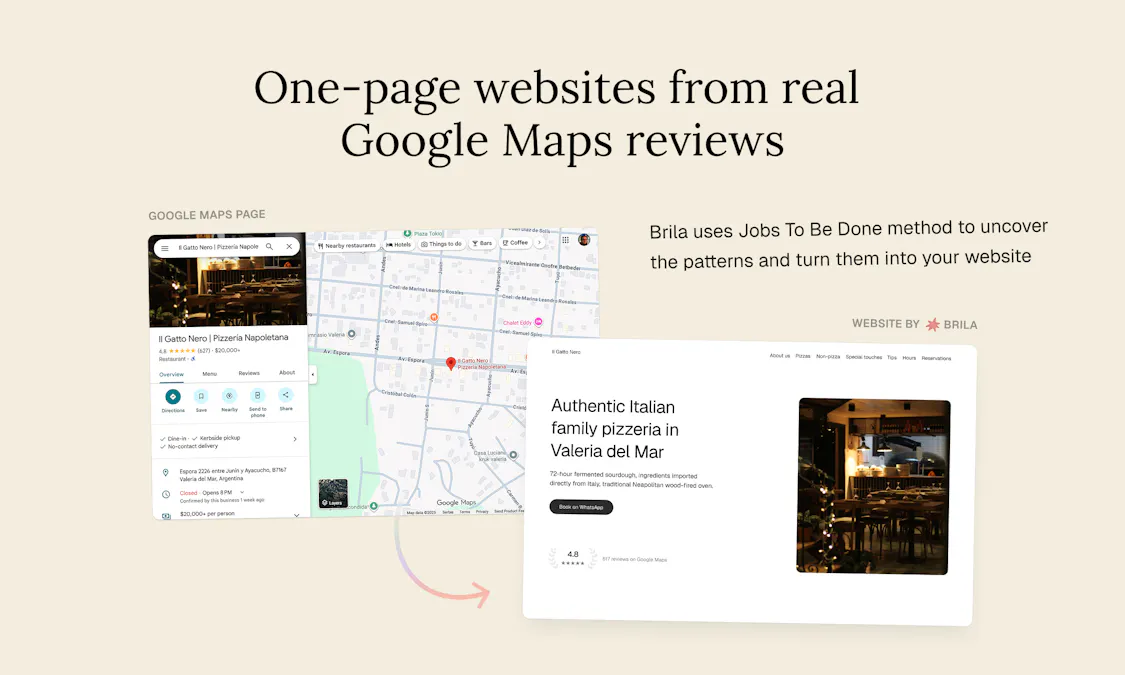
Brila (launched April 9, 2026) is built around that reality. Its pitch—turning real Google Maps reviews into a one-page website—doesn’t try to out-design Wix. It tries to out-trust it. It treats credibility as the scarce resource and assumes the best “copy” is what customers repeat in public.
This fits how people actually buy local services now. The path is messy: Maps to Instagram to TikTok to a booking link to a phone call. A multi-page brochure site often adds friction. For a plumber, salon, dentist, café, or studio, the real job is simple: answer what you do, show you’re good, and make the next step obvious.
Most SMB sites still read like self-portraits. Customers buy after they see outside proof.
Brila stands out because it doesn’t bolt reviews onto a site—it builds the site out of them.

What Brila builds: a single page where reviews drive the narrative
The workflow is simple: connect a Google Business Profile, import Google Maps reviews, then publish a one-page site where those reviews become structured sections. That choice changes the whole tone of the page. Instead of “we’re friendly and fast,” you get the language customers actually use—names, situations, specifics.
One-page sites aren’t a compromise for many local businesses; they’re the cleanest funnel. They load quickly on mobile, are easier to keep accurate, and concentrate attention on actions that matter: call, book, get directions, request a quote.
AI has made “acceptable design” cheap. The fight moved upstream to inputs: what data can you pull, how cleanly can you shape it, and how well does it turn into a page someone will trust in 10 seconds.
Why Google review text is a sharper starting point than blank sections
Brila is betting that Google’s review ecosystem is the closest thing local commerce has to a shared trust layer. Most site builders start with empty boxes: services, testimonials, why choose us. Brila starts with the hardest part already done—people saying what happened and how it felt.
- Believability: Reviews are unpolished. That messiness reads as real.
- Time saved: Owners don’t need to draft a brand voice document before they can publish something convincing.
Why “one page” is the point
For big brands, one page can’t hold the whole story. For local services, one page can do the job: what you do, where you do it, how to reach you, and enough social proof to remove doubt. Brila isn’t selling “a website.” It’s selling a short, credible front door.
Key Takeaway
Brila isn’t trying to win on templates. It’s trying to ship a site that borrows credibility from an existing review footprint—and puts that credibility on a domain the business controls.
The bigger idea: “reputation-as-content” and builders that compete on data access
Website builders used to fight over themes. That era is mostly over. The new contest is about connectors: which platforms can ingest high-signal data (reviews, menus, bookings, listings) and keep it consistent without the owner babysitting it.
Brila fits a trend: reviews and user-generated signals becoming the page, not an afterthought. It’s the same arc you’ve seen in other channels—people trust what other people say, and they trust it more when it’s specific and recent.
There’s a catch, and it’s not small. Tools that anchor themselves to a single external source are exposed to policy and access changes. Google controls Google reviews. If the access path tightens, the “wedge” gets weaker overnight. The durable version of this product category doesn’t rely on one pipe; it supports multiple sources and gives owners enough editing control that the site still stands on its own.
What Brila gets right is the direction: the website as a living surface composed from verified signals, not a static brochure full of claims.

Where Brila sits in a crowded builder market
“Website builder” is a crowded label that hides different jobs. Wix and Squarespace are broad business platforms. WordPress is a flexible ecosystem. Webflow is a pro tool. AI-first generators can spin up a decent-looking page from a prompt. Brila’s angle is narrower: take an existing Google reputation and turn it into a coherent pitch without asking the owner to write.
That makes the competitive landscape look different:
- Traditional builders: Wix and Squarespace can display reviews, but reviews aren’t the spine of the site. Their strength is coverage: ecommerce, scheduling, email, forms, apps.
- AI “instant site” tools: Durable and 10Web optimize for speed. The risk is sameness: prompt-driven pages often sound like everyone else.
- Reputation platforms: Podium, Birdeye, and NiceJob are built for review generation and management, with widgets and campaigns. They’re close by, but the website itself isn’t the main product.
Brila’s upside is clarity: stop writing promises and publish proof. Its exposure is also clear: if “Google reviews” is your core ingredient, you’re building on land you don’t own.
Table: How Brila compares with mainstream site builders and AI-first generators
| Product | What it optimizes for | Review-to-site automation | Typical pricing (USD) | Key differentiator |
|---|---|---|---|---|
| Brila | Fast, single-page local presence | Yes—built around Google Maps reviews | Varies; not clearly standardized publicly | Makes public proof the main content structure |
| Wix | Broad SMB site + marketing suite | Limited—mostly via apps/embeds | Tiered monthly plans | Breadth: apps, bookings, ecommerce, email |
| Squarespace | Design-first SMB sites | Limited—blocks/embeds | Tiered monthly plans | Strong templates and commerce features |
| Durable | Prompt-generated sites fast | No—prompt and business category driven | Tiered monthly plans | Speed plus bundled SMB utilities |
If this works, “a website” becomes a formatted reputation artifact
Brila doesn’t need to replace WordPress to matter. The bigger change is psychological: it makes it normal for the website to be a curated output of reputation, not a handcrafted brand document. Agencies hate that idea. Owners usually love it.
The best-fit customers are obvious: businesses with strong Google reviews and a weak or outdated site. For them, importing reviews into a clean page can remove weeks of stalled decisions: what to say, which testimonials to pick, what tone to use. On mobile, this format matches real behavior: scroll, scan, tap to call, book.
There’s also an operations loop here. If your website visibly improves when your reviews improve, then customer service and review collection stop being “nice-to-haves.” They become direct website inputs.
The hard part: making it feel like a site, not a Google wrapper
The product lives or dies on editorial intelligence. A wall of praise isn’t a pitch. The page needs to sort reviews into themes, pull out concrete services customers mention, and present proof with enough specificity that it answers real objections.
Durability is the other test. A tool that depends on one external feed needs a plan for interruptions: other review sources, first-party testimonials, and an editing model that keeps the site useful even if the import slows down or stops.

ICMD’s editorial take: Brila is interesting if it grows into the translation layer
SMB websites have been stuck in a bad middle ground: expensive agency builds that don’t get visited, or DIY sites that look fine but don’t say anything customers trust. Brila’s move is blunt and correct: stop drafting claims and start formatting evidence.
This only holds if Brila becomes more than an importer. The durable product is the place where a business shapes how reputation turns into an owned identity: categorized proof, synced business info, clean CTAs, and room for first-party content that compounds over time.
Google will always be the risk factor. A serious version of this company treats Google as the seed, not the whole garden.
If you’re evaluating Brila (or any review-driven builder), ask one question before you migrate anything: if Google access disappeared for a month, would your site still read like a complete business pitch—or would it collapse into an empty shell?